Absa's R8.8bn tech spend and its R200m software write-off
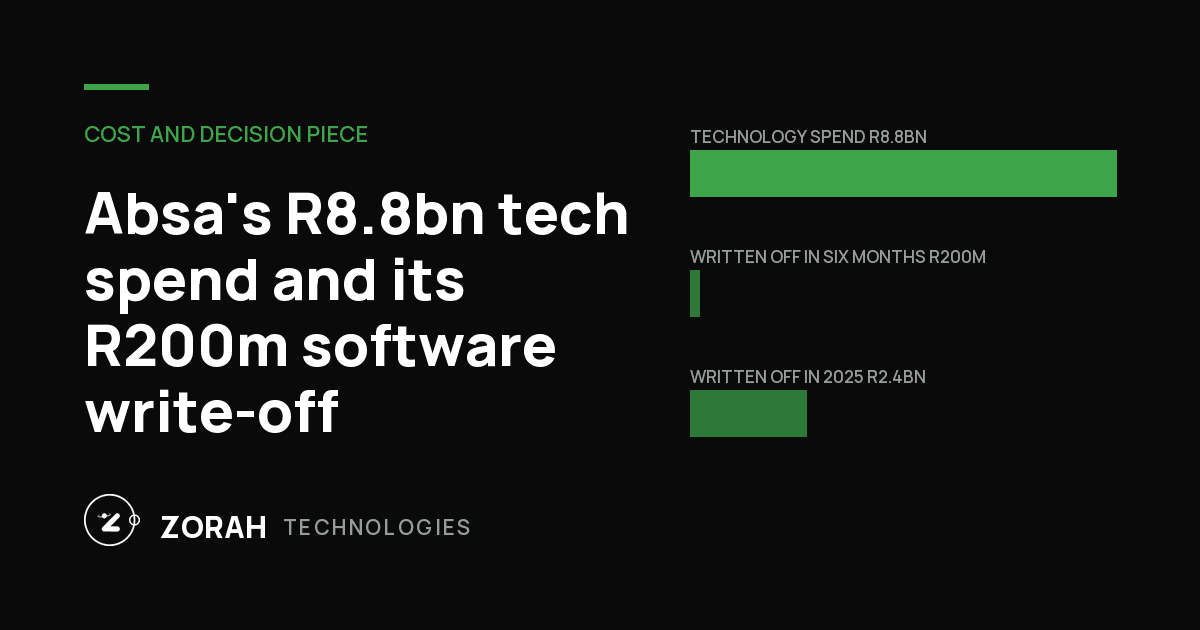
Absa spent R8.8 billion on technology in the first half of 2026 and wrote off R200 million of software as worthless in the same six months. For any South African business planning its own systems spend, the write-off is the more useful number of the two.
The headline figures were good. Headline earnings of R12.8 billion, up 8%. Return on equity up to 15%. More than 13.4 million customers across 17 countries, with digitally active customers up 14%.
The technology line underneath tells a different story, and it is one that scales down to a 60-person business almost exactly.
What R8.8 billion actually bought
Absa's interim results put total IT spend, including staff, amortisation and depreciation, up 7% to R8.8 billion. That is roughly 28% of the group's R31.4 billion operating expense base for the six months. It covers digital infrastructure, cloud, cyber security, data and AI work, and the people to run all of it. It also has to cover a real threat: Absa and its customers lost R129 million to fraud in South Africa over the same half.
So: more customers on digital, and a substantial bill for getting them there.
And yet the group's cost-to-income ratio went up, not down. More customers moved onto digital channels and the business got slightly more expensive to run, not less.
More digital adoption, more technology spend, and the business became slightly more expensive to run rather than less. That is the whole lesson, and it is worth sitting with before signing your next software order.
The R200 million is the part worth reading twice
In the same six months, Absa impaired another R200 million in software. That follows a R2.4 billion write-down disclosed in March for the 2025 full year, itself more than thirteen times the R179 million written off the year before. It is a pattern, and a steepening one.
The wording in the results matters. Absa said it "impaired certain software assets for which the value in use is determined to be zero, mainly derived from head office."
Value in use of zero. Not underperforming, not disappointing. Zero.
The stated reason is the important bit: "The impairments were mainly driven by changes in the Group's strategy, regulatory developments and the pace of technological change."
Read that carefully, because it is not an admission of having bought bad software. It is an admission that the software stopped fitting. The strategy moved, the regulations moved, the technology moved, and the systems could not move with them.
They were probably fine on the day they were signed off.
The same thing happens at 60 people. Nobody impairs it.
A distributor with 60 staff does not spend 28% of operating expenses on technology, and does not have a head office full of stranded platforms. But the difference between that business and Absa is not that one has software with a value in use of zero and the other doesn't. It is that Absa has to declare it in a public results statement.
In a smaller South African business the same write-off is sitting there undeclared:
-
The job management system bought for a branch structure you reorganised out of existence two years ago.
-
The stock module that duplicates what the accounting package already holds, so both are half-right.
-
Three separate subscriptions per user, because the quoting tool, the accounts package and the scheduling tool don't talk to each other.
-
The person whose actual job, if you wrote it down honestly, is being the integration between two systems.
None of that gets impaired. It just stays in the debit order, and it compounds, because every new tool you add has to be reconciled against the ones already there.
Why spending more doesn't make you cheaper to run
The Absa numbers separate two things that usually get treated as one: technology spend and operating leverage. Absa moved a lot of customers onto digital channels and its cost base still grew, because the new systems had to be funded while the old ones stayed alive alongside them.
That is the shape of the problem in a smaller business too, and it is where the money actually goes. Not the licences, which are usually the smallest line. The joins. The re-keying between the quote and the invoice. The spreadsheet that exists purely because two systems don't speak. The month-end that takes four days because three sources of truth have to be argued into agreement.
Buying another platform does not fix that. It adds a fourth source of truth.
The test to apply to your next spend
One question, applied honestly, filters most of it: does this join up something we already own, or does it add another thing to fund? If you can't answer that, the problem isn't the software decision. It's that nobody has established what the business actually runs, what each piece costs, and where the work genuinely slows down. That inventory is unglamorous and almost nobody has it.
A staged approach works better than a platform purchase, and it is the opposite of how software usually gets sold:
-
Establish what you already own and what it costs per month, in one list.
-
Find the single workflow where the real cost sits. It is rarely the one that feels most annoying.
-
Fix that one properly, and connect it to the tools you already run rather than replacing them.
-
Only then extend to the next workflow. The advantage of that order is that it fails cheaply. If step two turns out to be wrong, you have lost an audit, not a three-year licence and a migration. Absa can absorb a R2.4 billion write-down. A 60-person distributor writing off its core system does not get a second attempt.
This is the work Zorah does: a discovery audit to find where the bottleneck actually is, then joining up the systems a business already runs rather than replacing them with something new to fund. For operations and job management , where the gap between the quote, the job and the invoice is usually the expensive one, that is nearly always the cheaper route.
Absa's R200 million is a rounding error against its R8.8 billion. The equivalent write-off in a smaller business rarely is.