You have to spend it. This is where it goes.
South African companies are required to spend part of their profit developing black-owned suppliers. Most of that money buys a receipt. We turn it into a working system that lives inside the supplier’s business and reports back what it changed.
The five systems a small operator already runs. We attach to them. Nobody is asked to migrate anything.
The budget is compulsory. Somewhere worth putting it is not.
A legal obligation, not a donation, and the part of the scorecard companies handle worst.Enterprise and supplier development is a legal obligation, not a donation. It is also the part of the scorecard companies handle worst, and have for years.
A grant produces a receipt and nobody learns what happened to it. A training course ends. Neither makes the supplier better at supplying you, so procurement never cares, and next year starts from nothing.
Evidence of outcomes, not evidence of spend. Most of what corporates fund today cannot produce that, because nothing is left running once the money is gone.
A working system, placed inside the supplier's business.
Not a course and not a cheque. The supplier keeps it when the programme ends, which is what supplier development was always supposed to mean.
A transport contractor has a tracker because the insurer demands one, and an accounting package because SARS does. Asking them to abandon those is why most programmes are never adopted. We read from them instead.
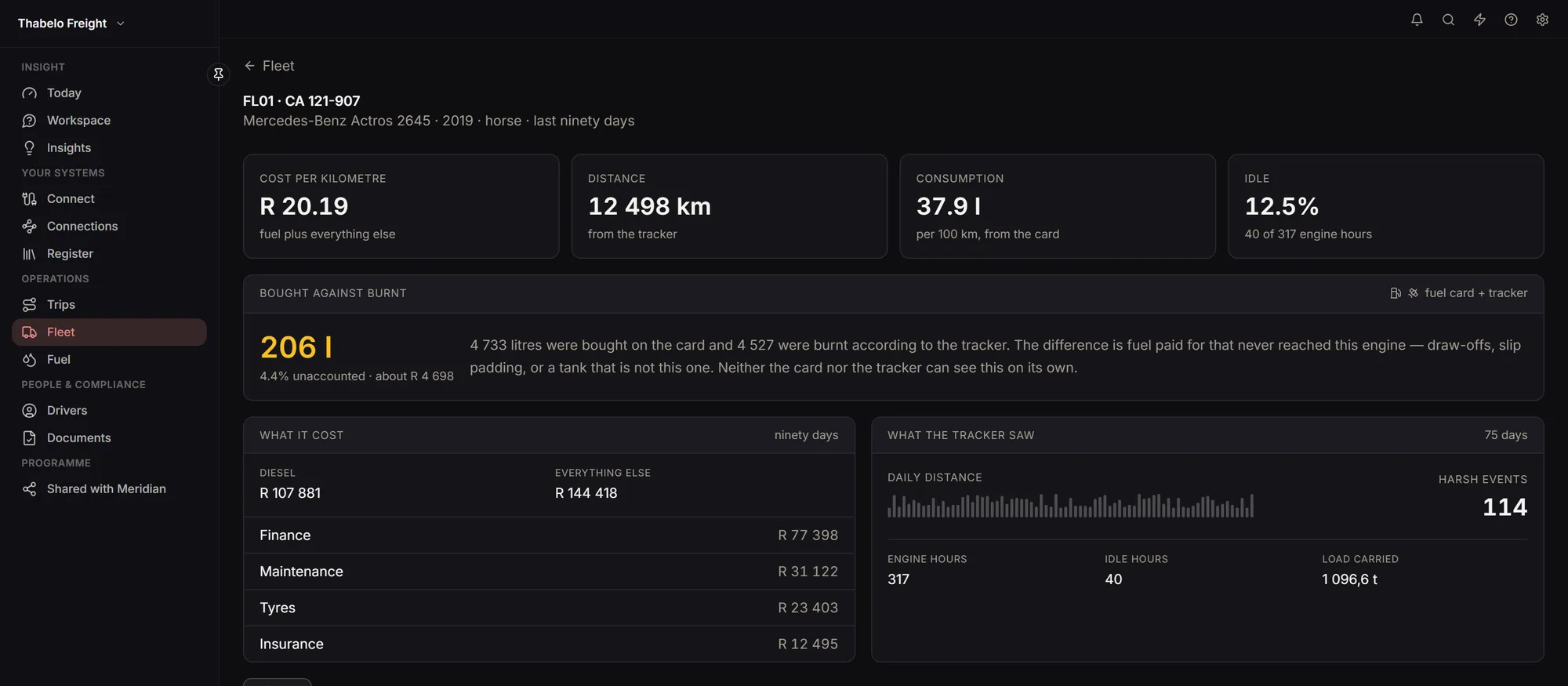
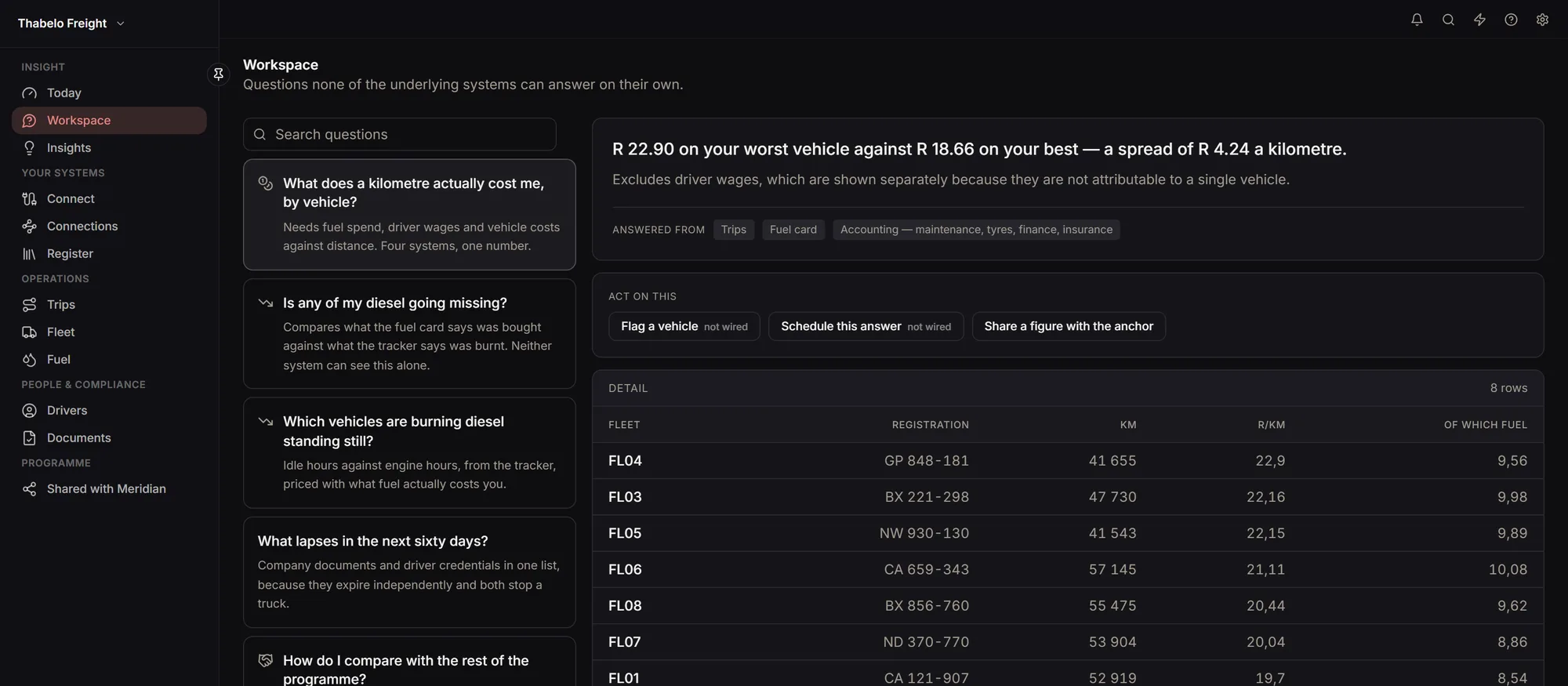
The fuel card knows litres bought. The tracker knows litres burnt. Neither sees the gap between them, and that gap is diesel paid for that never reached an engine. Every useful answer in the platform has this shape.
Adoption, outcomes, and the source of every figure, generated from the records rather than written up by somebody at year end. That is the part a grant can never do.
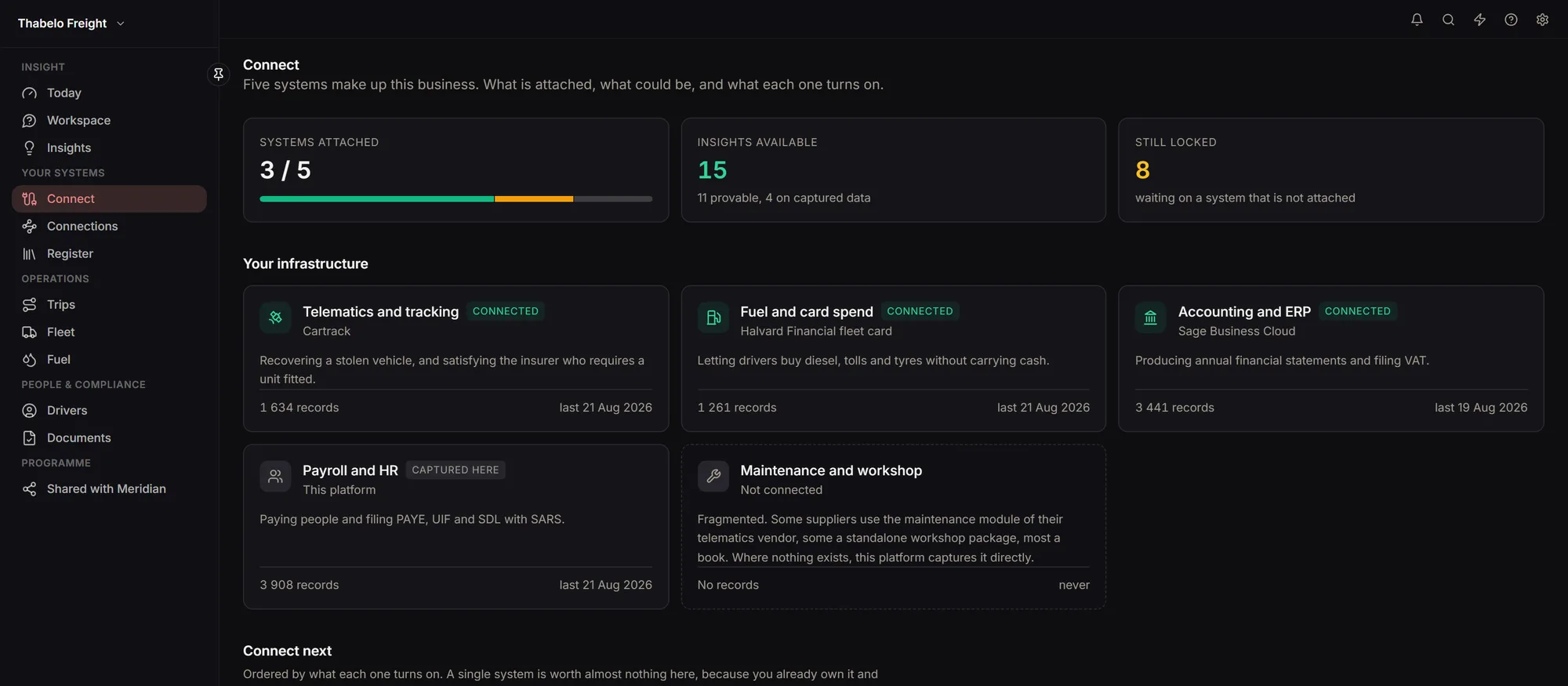
The supplier’s own screen. Three of five attached, and the platform is explicit about the two that are not.
Five systems, and every way we get into them.
27 connectors in the catalogue, 13 of them live today. Open a row to see all of them, and the state each one is actually in.
Bought for recovering a stolen vehicle, and satisfying an insurer who requires a unit fitted. The unit is wired into the vehicle and the contract runs 36 months.
- CartrackLive APILive
- MiX by PowerfleetLive APIIn build
- NetstarLive APIIn build
- CtrackLive APIIn build
- Tracker ConnectScheduled filePlanned
- WebfleetLive APIPlanned
Bought for letting drivers buy diesel, tolls and tyres without carrying cash. The card is issued by their bank and tied to the account the business runs on.
- Bank fleet cards (4 issuers)Scheduled fileLive
- Engen Fleet CardScheduled fileLive
- Shell CardScheduled fileLive
- Sasol Fleet CardScheduled fileIn build
- On-site bulk tankCaptured hereLive
Bought for producing annual financial statements and filing VAT. Their accountant works in it, and the year-end depends on it.
- Sage Business Cloud AccountingLive APILive
- XeroLive APILive
- Sage Pastel PartnerScheduled fileLive
- QuickBooks OnlineLive APIIn build
- Sage EvolutionScheduled fileIn build
- Zoho BooksLive APIPlanned
- SAP Business OneLive APIPlanned
Bought for paying people and filing PAYE, UIF and SDL with SARS. Changing it mid-tax-year is a job nobody volunteers for.
- SimplePayLive APILive
- PaySpaceLive APILive
- Sage VIP PremierScheduled fileLive
- Sage 300 PeopleLive APIIn build
- Xero PayrollLive APIIn build
Bought for nothing, usually. This is the fragmented one. Most of it lives in a book, which is why the platform can simply hold it.
- Workshop spreadsheetScheduled fileLive
- Captured on the platformCaptured hereLive
- Cartrack MaintenanceLive APIIn build
- MiX Fleet MaintenanceLive APIPlanned
Where a vendor publishes nothing usable, the stream is captured on the platform instead and the screens say so. Nothing here implies a feed that does not exist.
Everything held, and the obligation each part answers.
Twenty-three record types across six groups. The supplier can see every field held about them, which is the only reason they keep capturing.
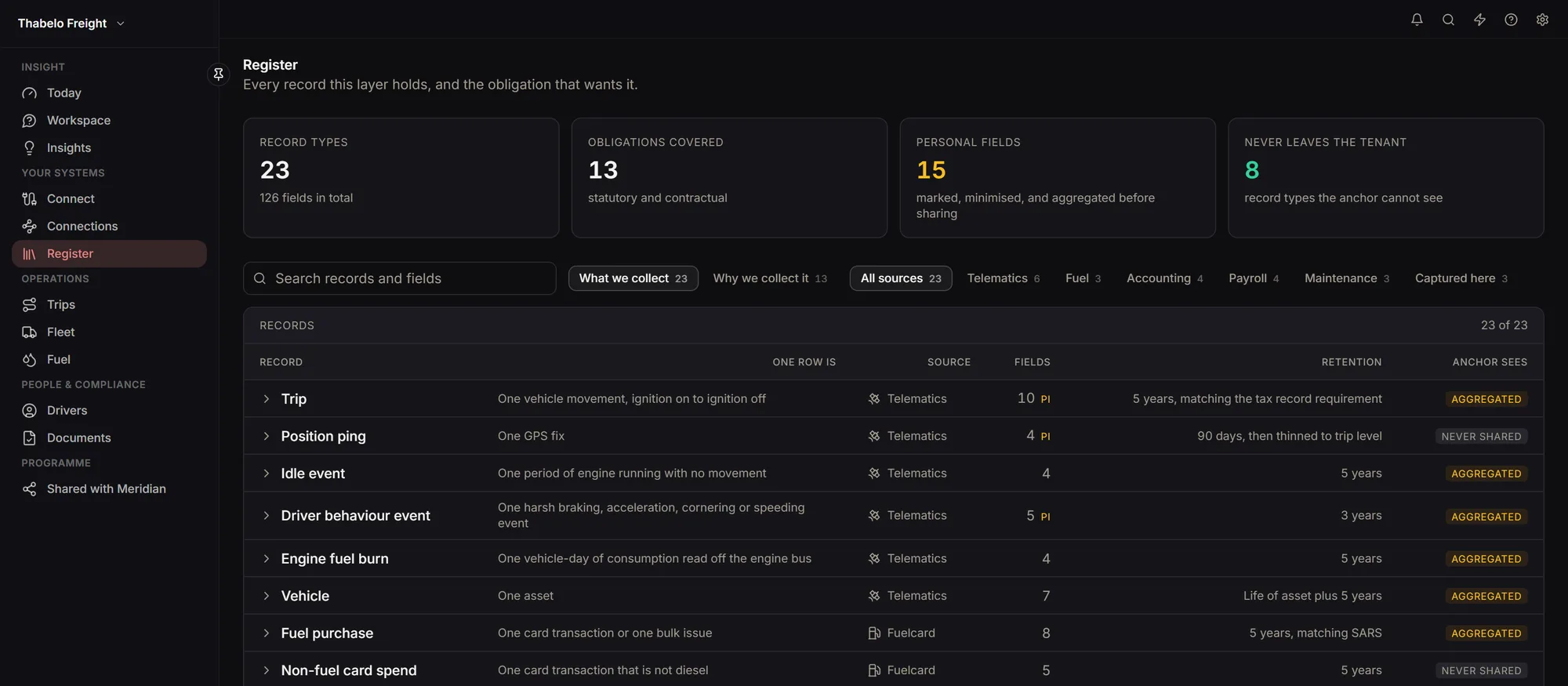
Personal information is marked as such and never crosses to you against a name, only as workforce totals. That boundary is enforced in the platform, not promised in a contract.
Answers the supplier's own vendors cannot produce.
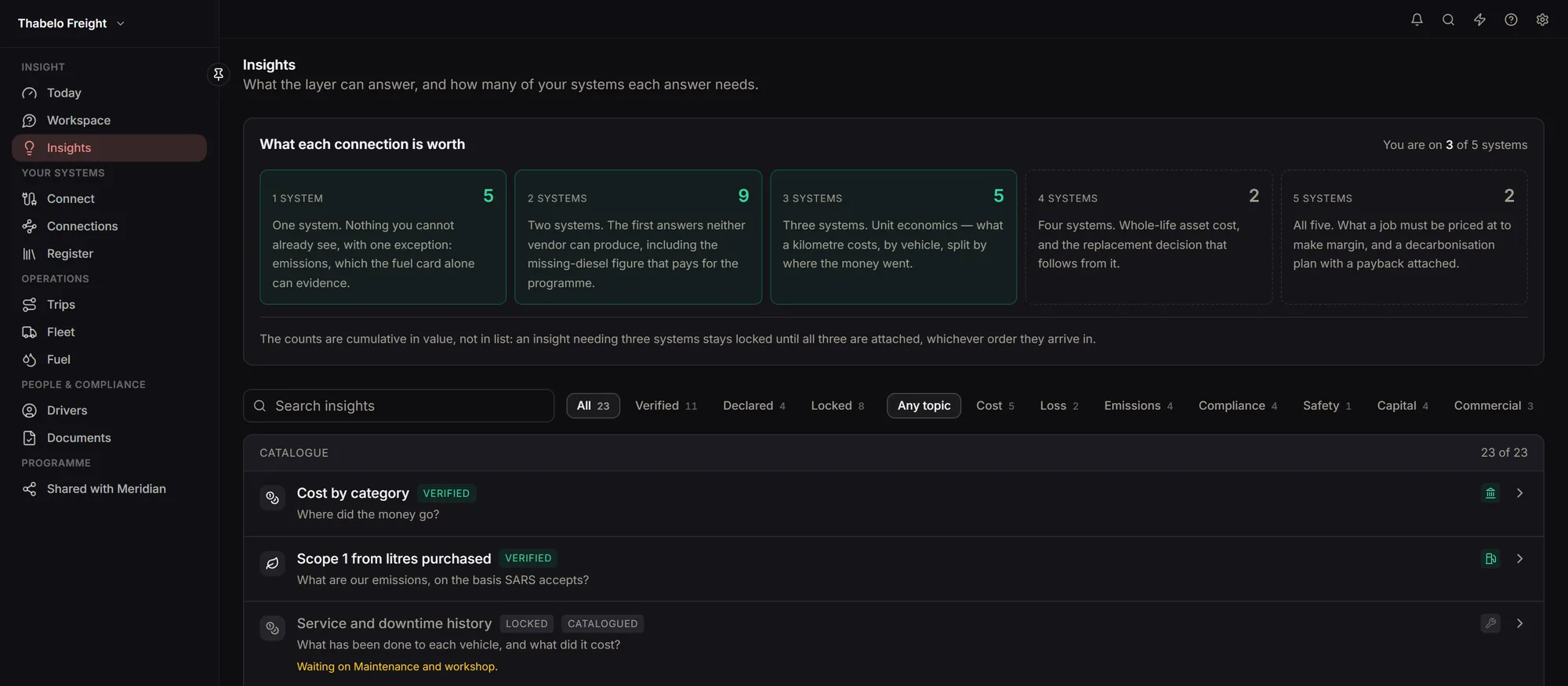
Twenty-three of them. Each names the systems it needed, and refuses to estimate the rest.
Litres bought on the card against litres burnt by the engine. The difference is fuel that never reached a vehicle.
Fuel, maintenance, finance and tyres against real distance, per vehicle.
Scope 1 derived from fuel records and checked against what was actually burnt.
Licences, operator cards and cover, with a warning before anything lapses.
Hours spent on the road against the hours they were paid for.
Whole-life cost against what it still earns, so replacement is a decision rather than a breakdown.
Every answer, and how many systems each needs before it can be produced at all.
Three parties, and each has to get something real.
A programme that only serves the scorecard is abandoned by the supplier inside a year.
- Knows what a job costs before quoting it, rather than after
- Finds fuel loss that was invisible to every system they owned
- Produces a compliance record on demand, not reconstructed at year end
- Keeps the platform when the programme ends
- Fully claimable supplier or enterprise development
- Adoption and outcome evidence per beneficiary, every quarter
- Suppliers who quote faster and deliver more reliably
- A programme still producing value after the financial year closes
- Drivers paid for the hours they actually worked
- Expired licences caught before a roadblock finds them
- Safety incidents recorded properly rather than absorbed
- Skills and training tracked against a person, not a spreadsheet
At the end of the quarter, the report writes itself.
Built from the same records the supplier reads about their own business, so it cannot disagree with what they see.
Active users, logins, records created and transactions processed, per beneficiary.
Response times, admin hours removed, systems retired, revenue movement, jobs created.
Access control, audit trail, and how personal information is handled under POPIA.
For every figure: which system it came from, and whether it was pulled or declared.
The platform also reports how much of the programme is not yet coming from a connected system. Every ESD report that shows only its successes asks a transformation manager to sign something they cannot defend. Stating the gaps is what makes the rest of it credible at verification.
Every supplier in the programme, with figures derived from their own records.
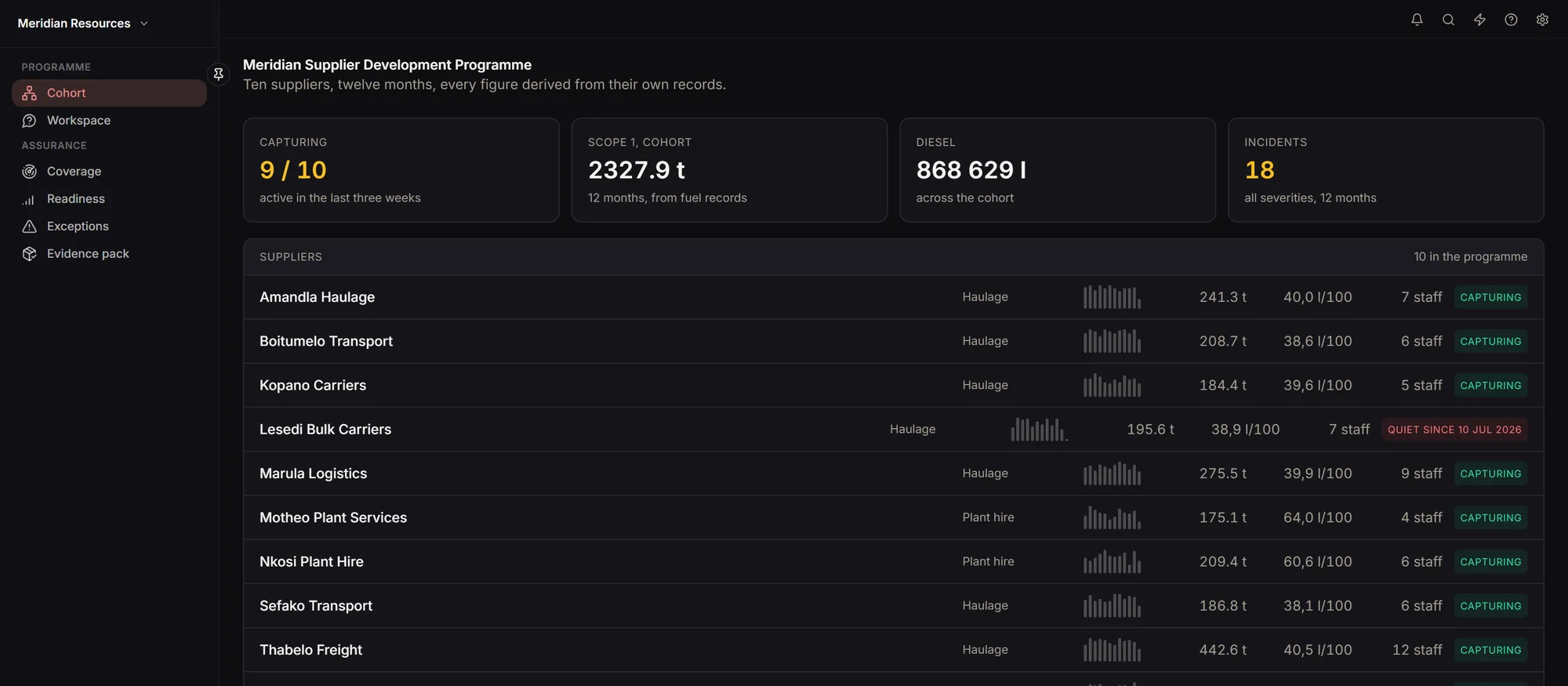
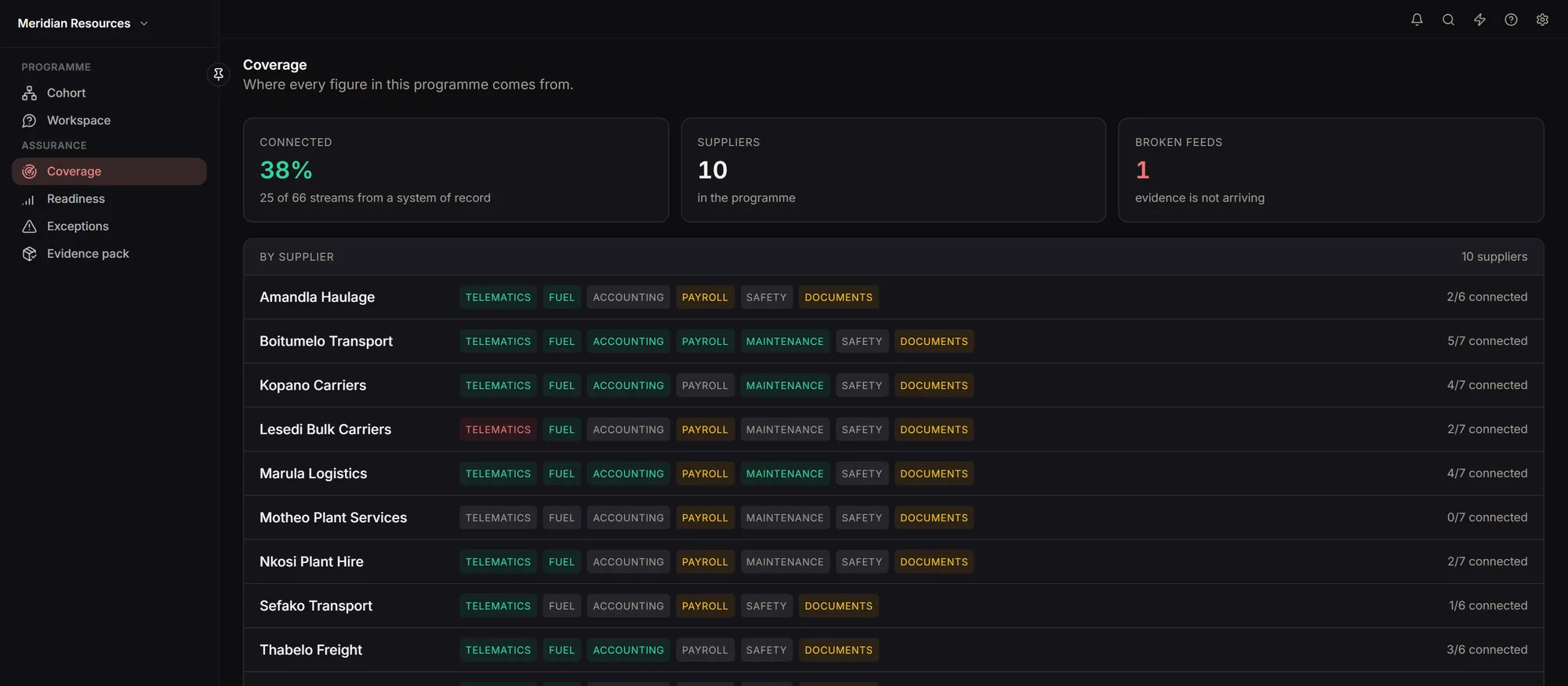
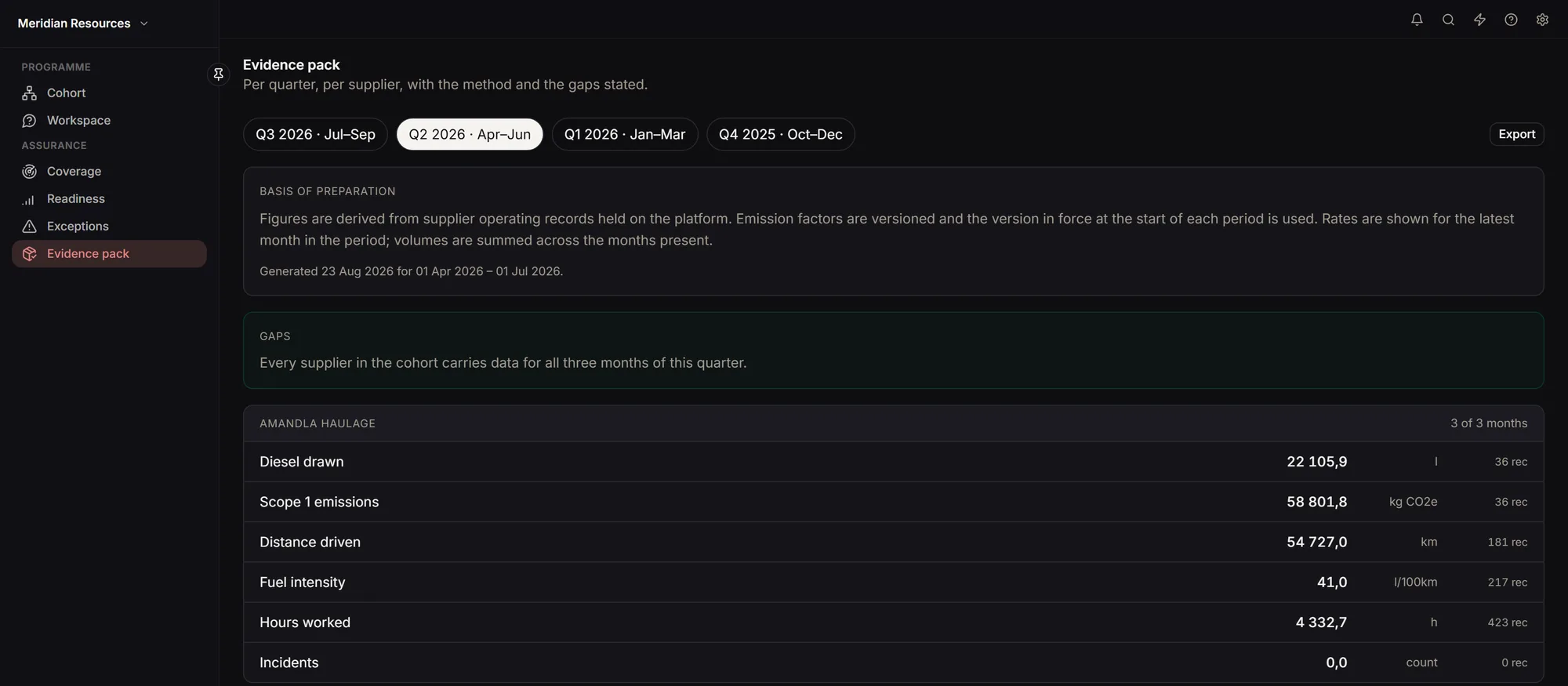
The screens on this page are the live platform, captured as it renders. The companies, people, vehicles and figures in them are generated for demonstration. No client of ours appears anywhere on this page.
What transformation teams usually ask.
See it on your business.
We build a version around what you sell and how you quote it, and show you it working. No paid audit, no obligation.