The plant is down while you are pricing. Bearings, fasteners, abrasives, PPE, lubricants and welding consumables, quoted against a live stock figure while the line is stopped. What you do not have on the shelf is bought in on the same document, with a date the customer can plan around.
A breakdown list is read into catalogue lines and priced against what is on the shelf right now, so the answer goes back in minutes rather than after somebody walks the stores.
The one line you do not carry raises a purchase order against the supplier who does, and that supplier’s lead time becomes the date on the quote.
A same-day callout and a scheduled shutdown list sit on the same account and the same statement, rather than in two different conversations.
In maintenance supply the enquiry usually arrives because something has broken. Speed is not a nicety and neither is honesty about stock: a part promised and then not delivered costs the customer more than a slower quote would have.
This is what arrives. Not a form, not a structured order. An email written by somebody in a hurry.
RFQ 4471: urgent, please quote today
Morning,

Breakdown on number 3 mill. Please quote and confirm stock on the following, we need it on site today if possible:

- 6x 6205-2RS deep groove bearing
- 200x M10 x 50 hex bolt, galvanised
- 4x 115mm cutting disc
- 1x hydraulic hose assembly, 2m, crimped both ends

If anything is not on the shelf please tell me now rather than after I raise the order.

Jaco: Rustenburg Shaft Services
Four lines, four different parts of the catalogue, and a customer who has explicitly asked you not to guess.
Read into lines, not retyped
The bearing, the bolts, the discs and the hose become four catalogue lines with codes and prices on them, without anyone opening a price list.
Checked against the floor
Each line is set against what is on hand and what is already allocated elsewhere, so the answer to his last sentence is on the quote rather than in a follow-up call.
The short line bought in
The hose assembly he needs is not stock. A purchase order goes to the supplier who makes it up, carrying that supplier's lead time onto the quote as a real date.
One document to the invoice
When he accepts, the quote becomes the order with the same lines and the same prices, and the invoice is raised off what actually left the building.
From a list of parts to money in the bank. Six steps, and nothing is typed twice. The quote becomes the order, the order becomes the invoice, and the figures cannot disagree.
The enquiry arrives as a list of parts
A customer sends a request, usually as prose with part numbers buried in it. It lands in one inbox and is read into lines the catalogue recognises, rather than retyped by whoever picks it up.
Priced against stock you actually hold
Each line is checked against the floor: what is available, what is already allocated to another order, and what is in transit. A quote does not promise a part that is spoken for.
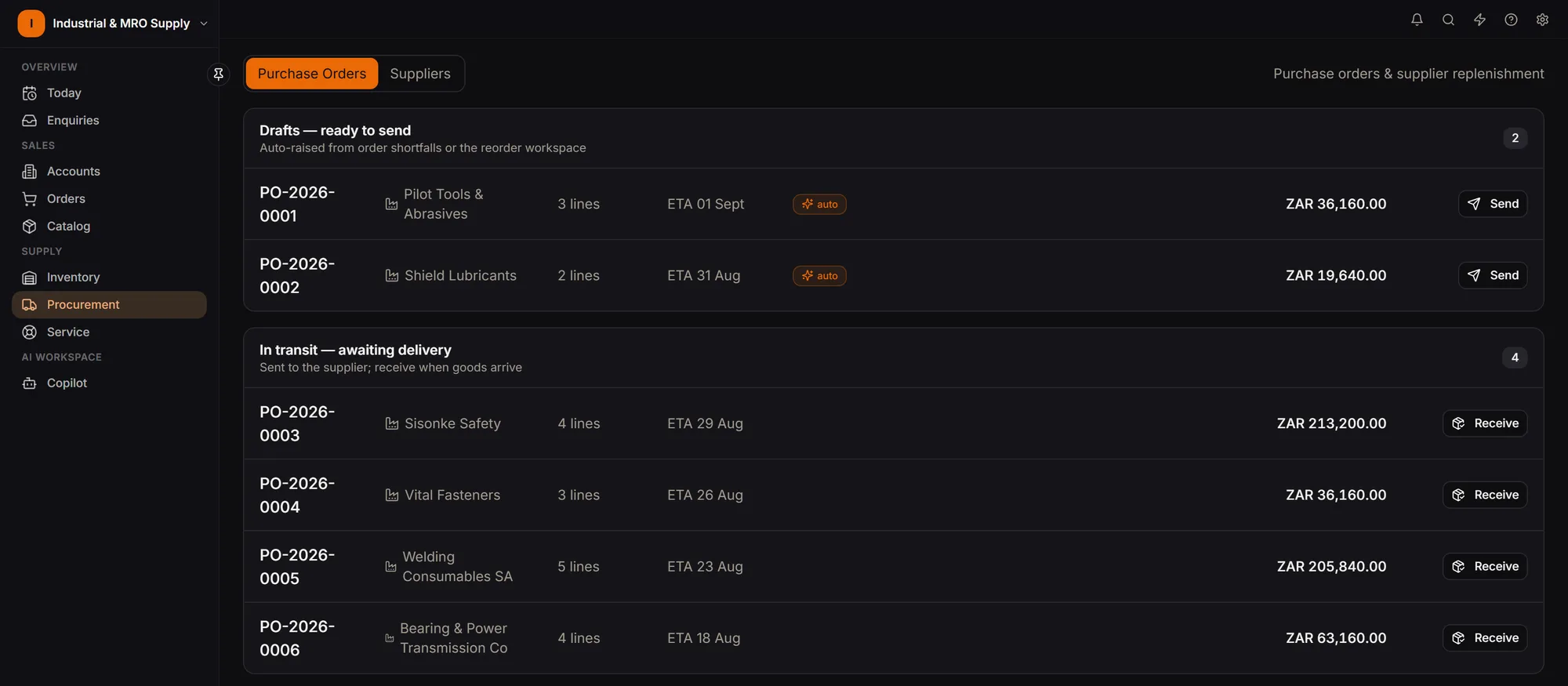
What is short goes onto a purchase order
A shortfall raises a purchase order against the supplier who carries that part, with its lead time on it. The customer is told a real date rather than an optimistic one, and receiving closes the loop when it lands.
The quote goes out, and is chased
A quote that nobody follows up is a discount you already gave away. Quotations carry an expiry and sit on a follow-up list, so the ones going cold are visible while there is still something to save.
Accepted, it becomes an order to pick
The accepted quote turns into an order with the same lines and the same prices, stock is allocated against it, and it drops into the picking queue. Nothing is captured a second time.
Despatched, invoiced, and watched until paid
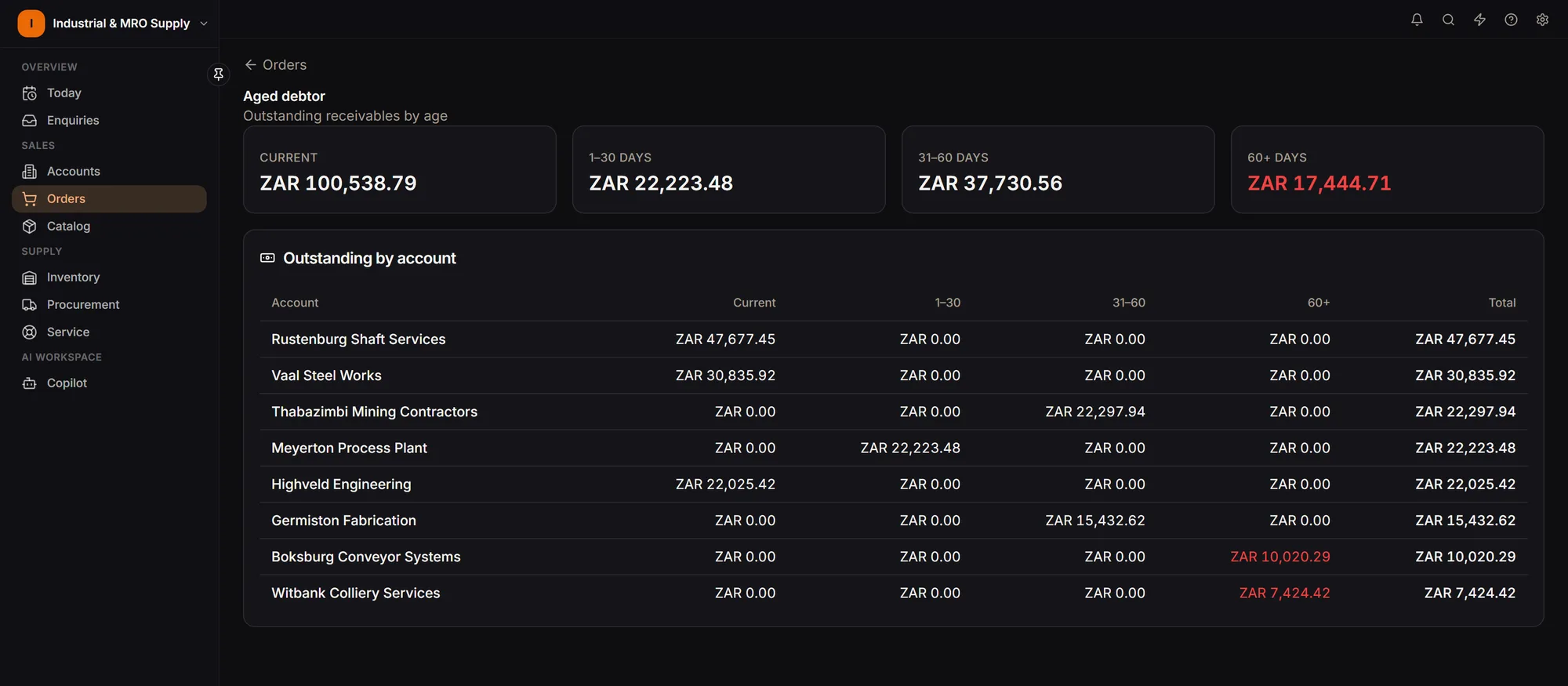
Proof of delivery closes the order and raises the invoice off the same lines. From there it sits on the aged debtor until it is settled, so what is owed and how long it has been owed is one number, not a spreadsheet.
One part, four prices, none of them wrong. A maintenance supplier does not have a price list. It has a price per account, per quantity and per contract, and whoever is quoting has to get the right one without looking it up.
- Cash / walk-inR 248.0042%Retail, over the counter
- Trade accountR 211.0033%Held against the part
- WholesaleR 196.0028%Held against the part
- Volume break, 100+R 179.0021%Applied at the quantity quoted
- CostR 142.00On every line, so margin is never a guess
The tier decides the price
Retail, trade and wholesale are held against the part itself and applied by the account being quoted, so a new person on the counter cannot pick the wrong one.
Bought from three suppliers, at three costs
The same bearing arrives at different cost depending on who had it. Cost sits on the line, so the margin you are quoting is the real one.
A quote expires on a date
Validity is stated on the document rather than assumed, so an order placed six weeks later is repriced deliberately instead of honoured by accident.
Urgency does not cost you margin
A breakdown quote is built at the same speed and the same discipline as a planned one, which is when discounting usually happens by accident.
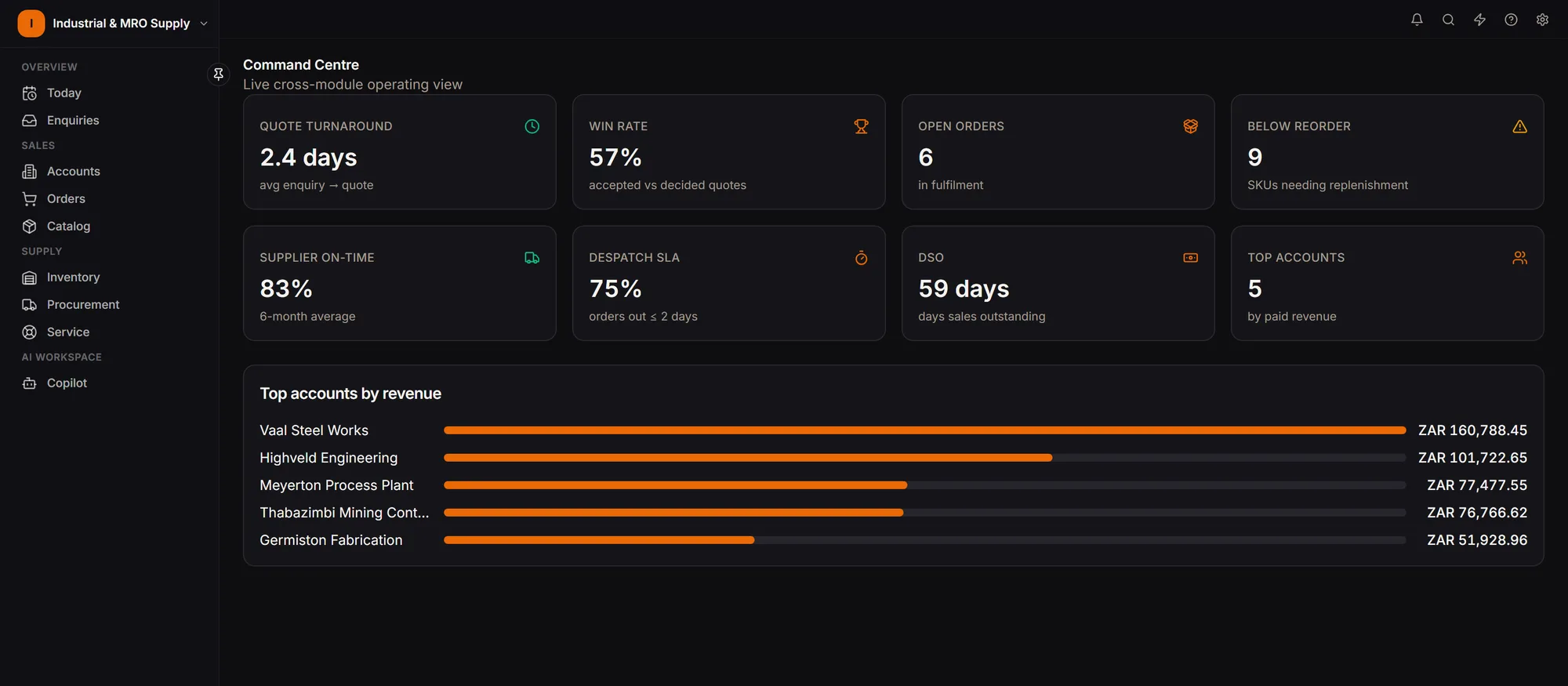
Industrial & MRO Supply, Germiston. 38 catalogue lines, with the quotes, orders, purchase orders and debtor book behind them.
Quote turnaround, win rate, what is below reorder point, and whether your suppliers are actually hitting the dates they promised.
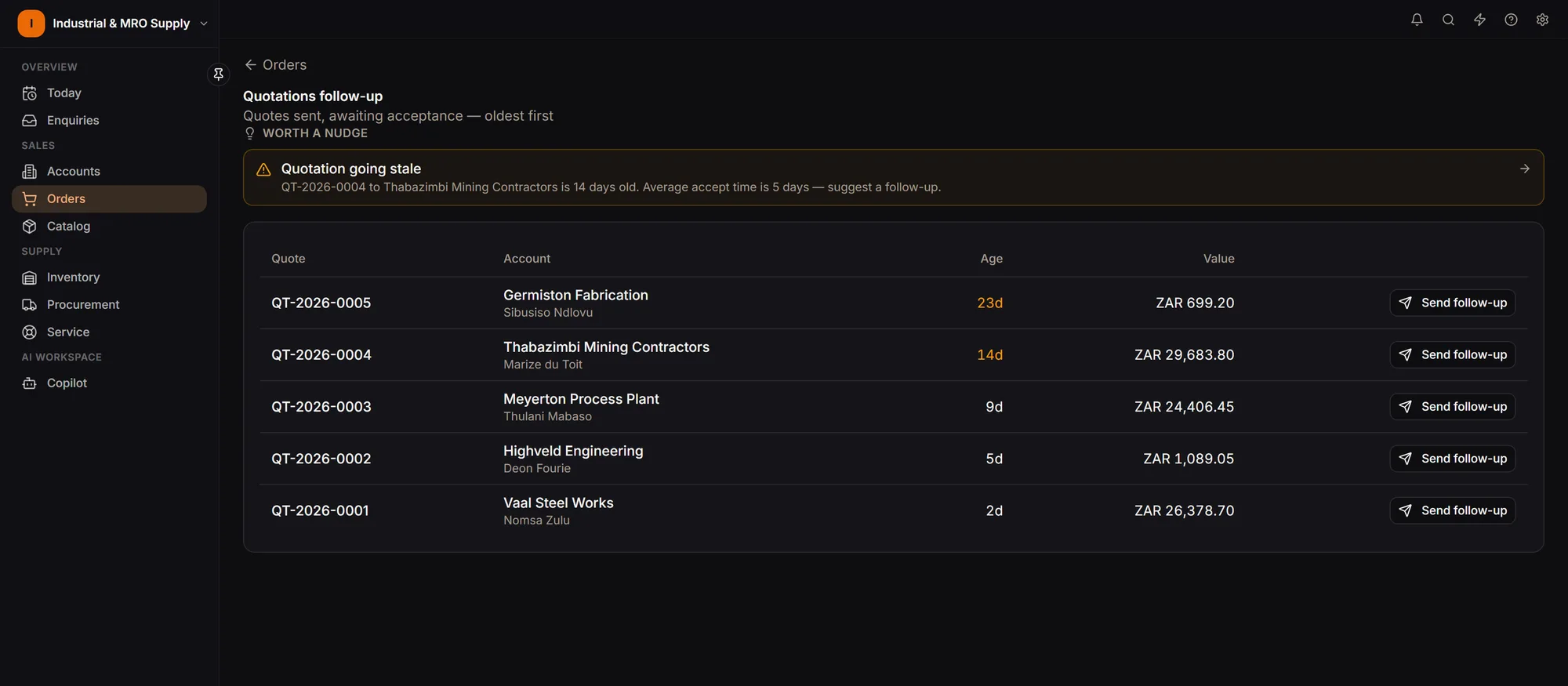
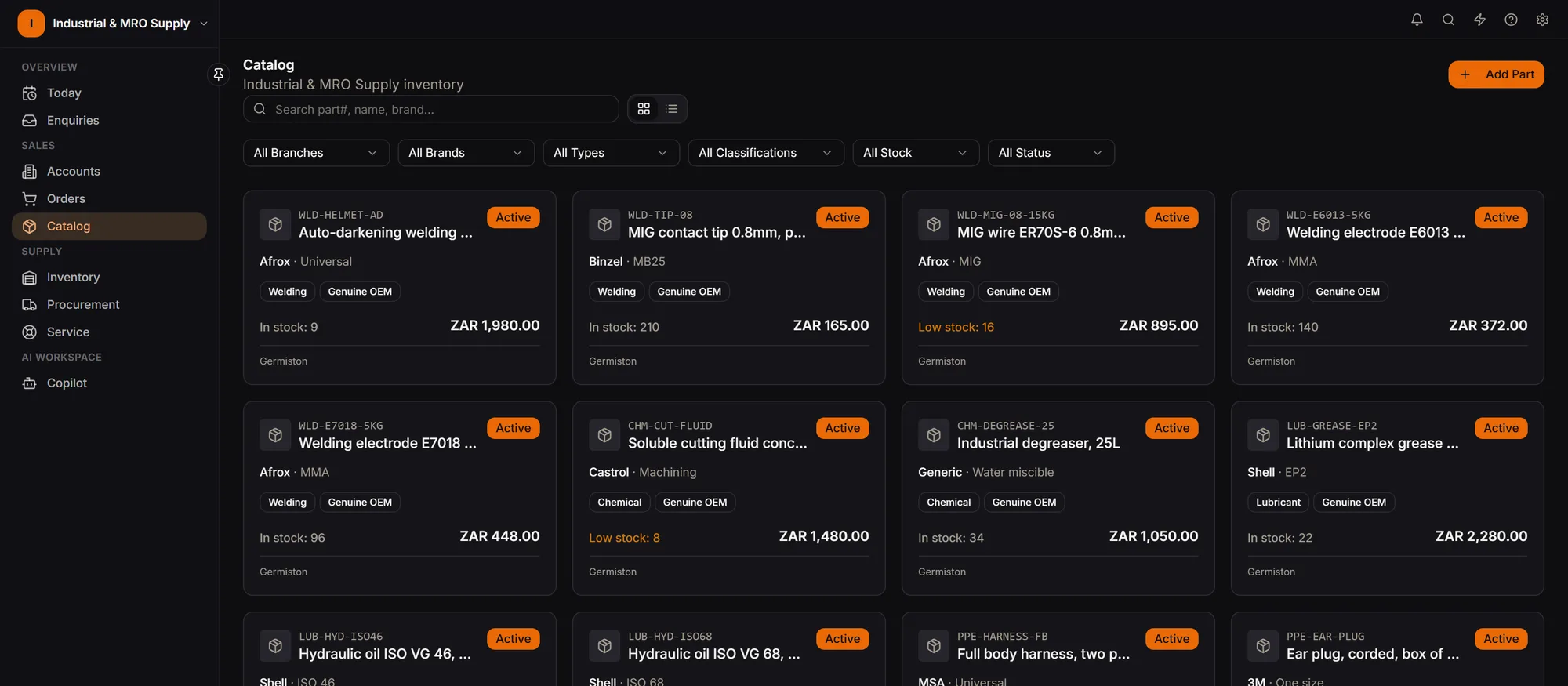
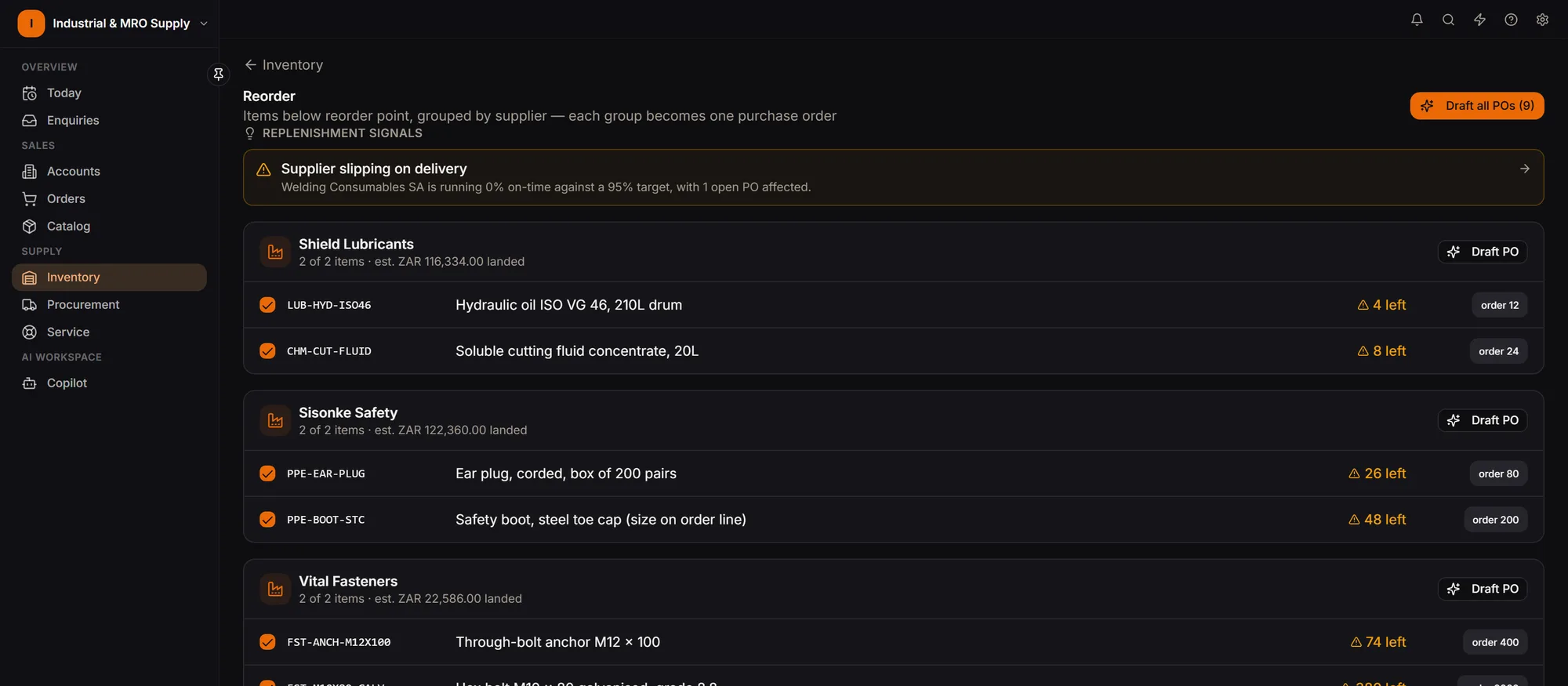
This trade does not lose money on one big thing. It loses it four small ways, every week, and none of them shows up until the year end.
The part promised that was not there
Quoted off a stock figure somebody remembered, then found allocated to another job. The customer is already down, and now they are down for longer.
Each line is checked against what is available and what is allocated, so the quote cannot promise a part that is spoken for.
The fast mover nobody watched
Cutting discs, rod and fasteners run out between counts, and the next enquiry for them becomes a lost order rather than a purchase order.
Reorder points are held per line against real movement and raise the purchase order before the shelf is empty.
The emergency quoted at the wrong price
A part bought in at spot cost, quoted at last month’s margin, and the difference is only found when somebody looks at the job.
Cost is read at the moment of quoting, so a line bought in expensively is seen as thin before it is sent.
The account that quietly went past terms
Credit extended to a mine that always pays, then extended again, until the oldest bucket is a month of profit.
What is owed and how long it has been owed sits on one screen, current through ninety days, in rand.
Nothing runs out quietly. Reorder points are held against real movement, so a shortfall is raised as a purchase order before it becomes a lost order.
Held against actual movement, rather than a number somebody set two years ago and never revisited.
The date the customer is given comes from the supplier who carries that part, not from optimism.
Stock booked in lands against the order that was waiting for it, and the short line on that job clears itself.
The screens on this page are the live platform, captured as it renders. The company, its customers, suppliers and every figure are generated for demonstration. No client of ours appears anywhere on this page.
Nothing that already works has to move. The finance team keeps their ledger, the branches keep their stock, and the counter keeps its speed. This sits over the top of all of it.
Your accounting package
Sage, Pastel, Xero or whatever the year end runs on stays where it is. Invoices raised here reach it, and the bookkeeper is not asked to learn a new ledger.
Your branches
Stock sits per branch and is quoted per branch, with what is available at the counter separated from what is sitting at another store or already in transit.
Your part numbers
Your own code, the supplier's and the OEM number all sit on the same line, so nobody has to translate between them mid-enquiry.
Your terms
Credit limits, payment terms and settlement discounts are held against the account and enforced when the order is taken, not discovered at month end.
Your counter
A walk-in is served at the same speed as before. The system is behind the counter rather than in front of it.
Your reps
What a rep quoted, what it was worth and whether it landed is on the account rather than in their own notebook.
Other distribution industries. Different stock and different customers, on the same run from enquiry to invoice.
Trade counter
Electrical and lighting wholesale, Plumbing and sanitaryware, Building materials and hardware, and 1 more
High-SKU parts
Auto parts and spares, IT hardware and print consumables, Electronics components
Made to spec
Packaging and labelling, Office furniture and stationery, Uniforms and workwear
Contract & tender
Medical and dental consumables, Laboratory and scientific supply, Mining consumables and spares, and 3 more
Or see the distribution overview.
What industrial and MRO distributors ask.
See it on your business.
We build a version around what you sell and how you quote it, and show you it working. No paid audit, no obligation.