There is no part number, because the part does not exist yet. Cartons, labels, films, furniture and workwear quoted from a material, a run length and an artwork rather than from a catalogue line. The quote has to be a real number before anything has been made.
A carton described by material, flute, colours and dieline is quoted as a real line with a real price, without anything having to exist in a catalogue first.
Asked to price twenty thousand and forty thousand, the quote is duplicated and repriced rather than rebuilt, so a comparison takes minutes.
The pallet wrap off the shelf and the printed carton being made travel on one order through the same pick, despatch and invoice.
Most distribution software assumes the thing being sold already exists in a catalogue. In made-to-spec trades it does not: the line is described into being on the quote itself, and that description has to survive all the way to the invoice.
This is what arrives. Not a form, not a structured order. An email written by somebody in a hurry.
New SKU, need pricing on cartons and labels
Hi,

We are launching a new line and need pricing before we sign off the artwork.

- 20 000x printed carton, B-flute, 4 colour (spec and dieline attached)
- 50 000x self-adhesive label 90x50 gloss
- 1x origination and plates
- 40x pallet wrap 500mm

Can you also price the carton at 40 000 so we can compare?

Marlize, Highveld Food Manufacturing
Two made-to-spec lines, one origination charge, one stock item, and a request to price the same thing twice at two run lengths.
Lines that need no catalogue entry
The printed carton carries its own description and its own price on the quote. Nothing has to exist as a stock code before it can be quoted.
Spec written where it will be read
Material, flute, colours and size sit on the line itself, so what was quoted states exactly what it was quoted against.
Stock and made-to-spec on one document
The pallet wrap comes off the shelf, the cartons are made. The customer gets one quote and one order, not two conversations.
The second run length priced too
The quote is duplicated and repriced at 40 000 rather than rebuilt from a blank page, which is what makes a comparison take minutes.
From a list of parts to money in the bank. Six steps, and nothing is typed twice. The quote becomes the order, the order becomes the invoice, and the figures cannot disagree.
The enquiry arrives as a list of parts
A customer sends a request, usually as prose with part numbers buried in it. It lands in one inbox and is read into lines the catalogue recognises, rather than retyped by whoever picks it up.
Priced against stock you actually hold
Each line is checked against the floor: what is available, what is already allocated to another order, and what is in transit. A quote does not promise a part that is spoken for.
What is short goes onto a purchase order
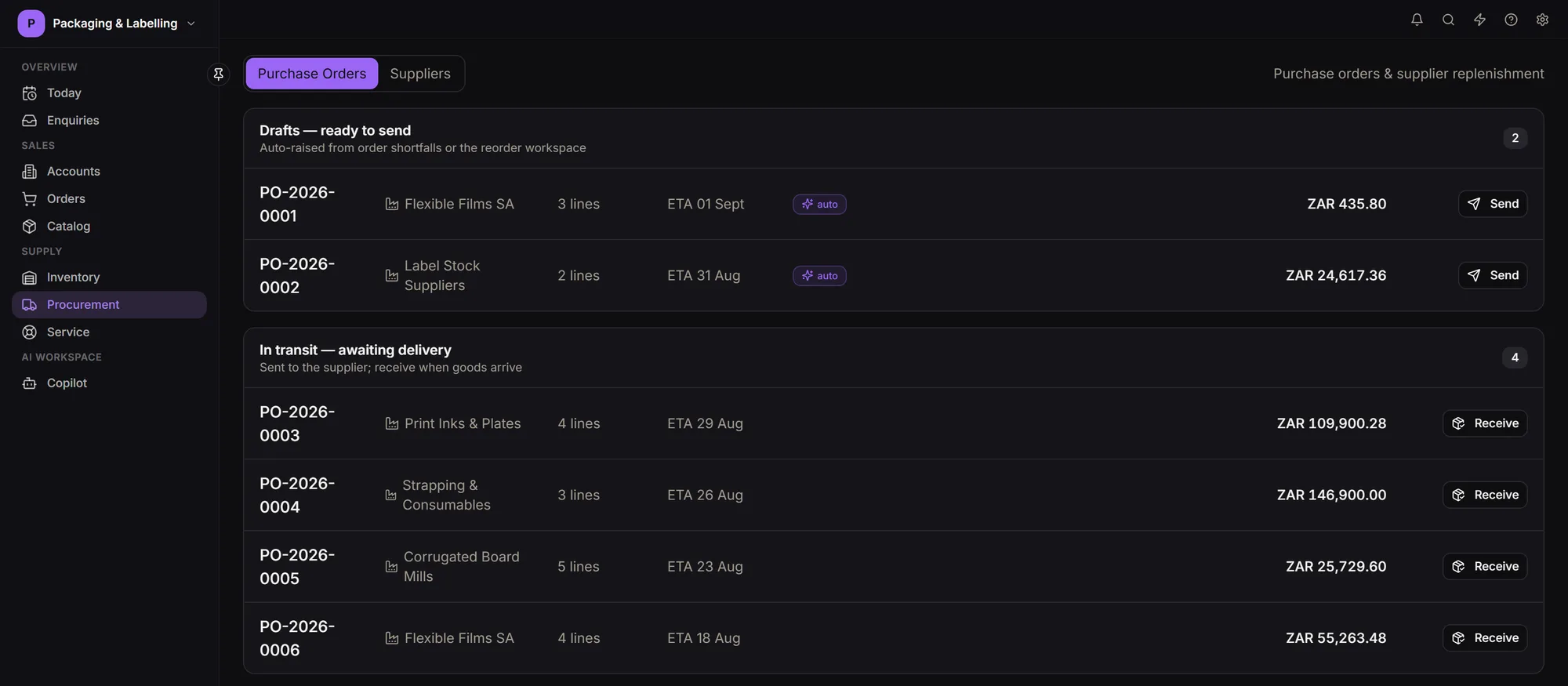
A shortfall raises a purchase order against the supplier who carries that part, with its lead time on it. The customer is told a real date rather than an optimistic one, and receiving closes the loop when it lands.
The quote goes out, and is chased
A quote that nobody follows up is a discount you already gave away. Quotations carry an expiry and sit on a follow-up list, so the ones going cold are visible while there is still something to save.
Accepted, it becomes an order to pick
The accepted quote turns into an order with the same lines and the same prices, stock is allocated against it, and it drops into the picking queue. Nothing is captured a second time.
Despatched, invoiced, and watched until paid
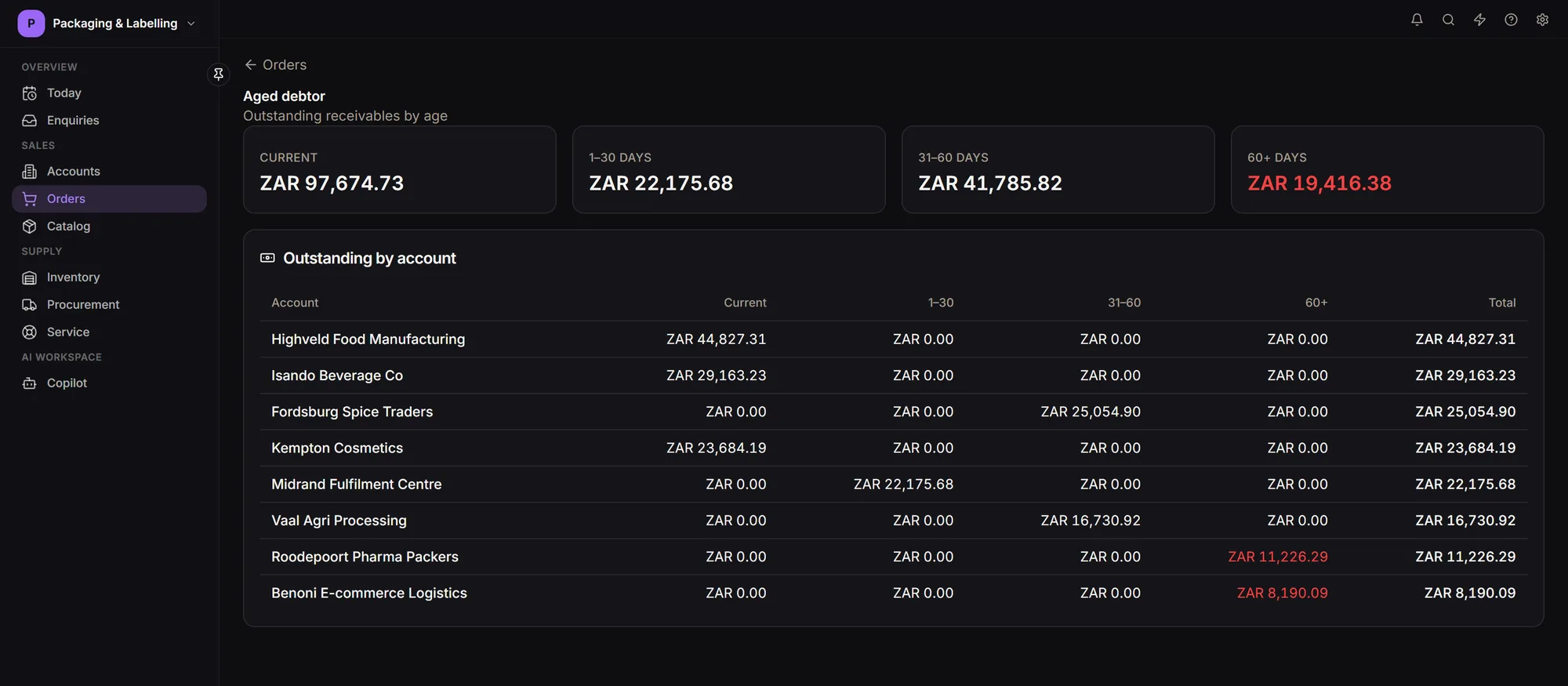
Proof of delivery closes the order and raises the invoice off the same lines. From there it sits on the aged debtor until it is settled, so what is owed and how long it has been owed is one number, not a spreadsheet.
One carton, four prices, and the run length decides. In made-to-spec supply the quantity is the price. The same specification costs a different amount per unit at five thousand and at forty thousand, and the quote has to say so without anyone working it out by hand.
- Sample / short runR 8.2044%Under 5 000, per unit
- 20 000 runR 6.9734%The quantity enquired about
- 40 000 runR 6.4829%The comparison they asked for
- 100 000 runR 5.9022%Applied at the quantity quoted
- CostR 4.60On every line, so margin is never a guess
The line is described, not selected
A quote line carries its own description and its own price, so a product that has never been made before can still be priced properly.
Origination is its own line
Plates, dies and setup are quoted where the customer can see them rather than buried in a unit rate they will query later.
Requote without rebuilding
The previous quote is duplicated and repriced, which is how a repeat run and a changed quantity both take minutes.
The specification survives to the invoice
Material, size, colours and finish are written where the price is, so a query six months later resolves into a record.
Packaging & Labelling, Isando. 24 catalogue lines, with the quotes, orders, purchase orders and debtor book behind them.
Turnaround from enquiry to quote, win rate, what is in fulfilment, and the stock lines running short.
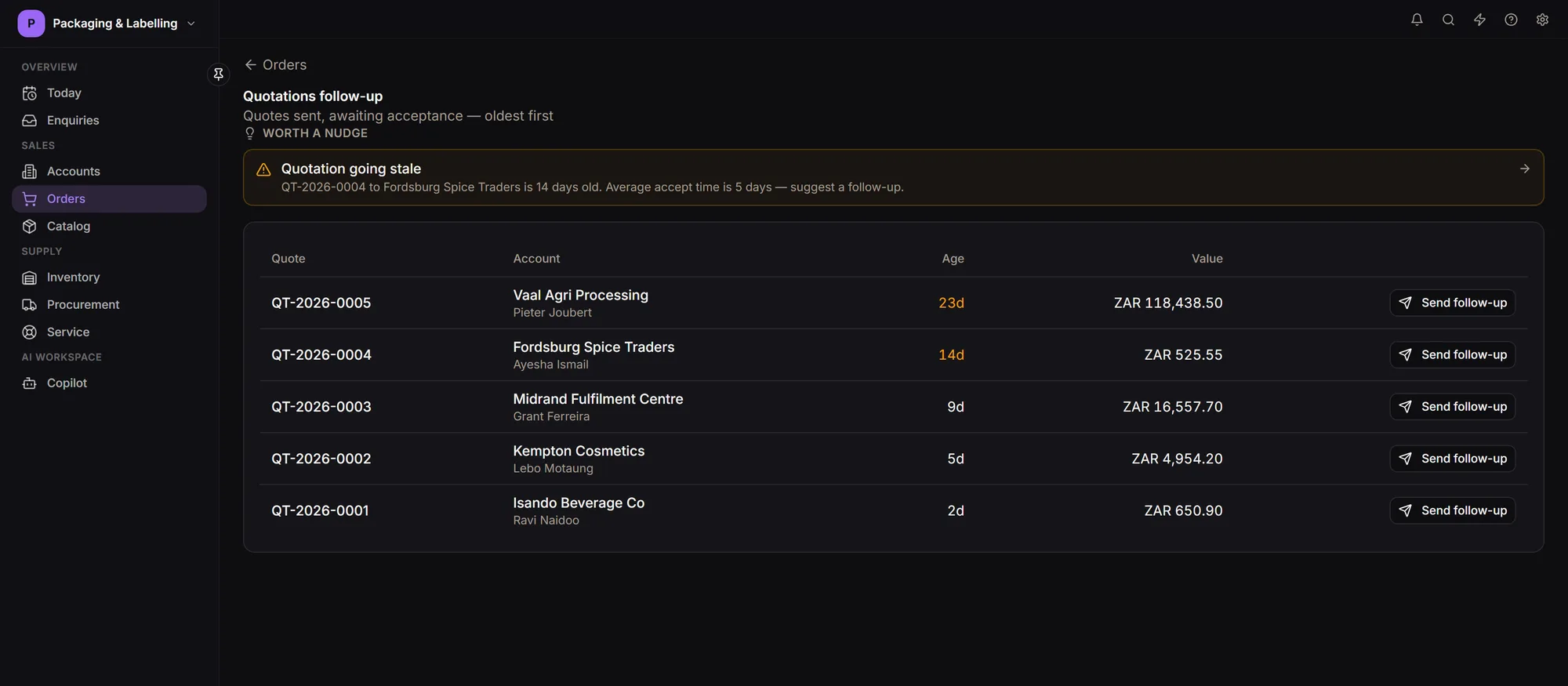
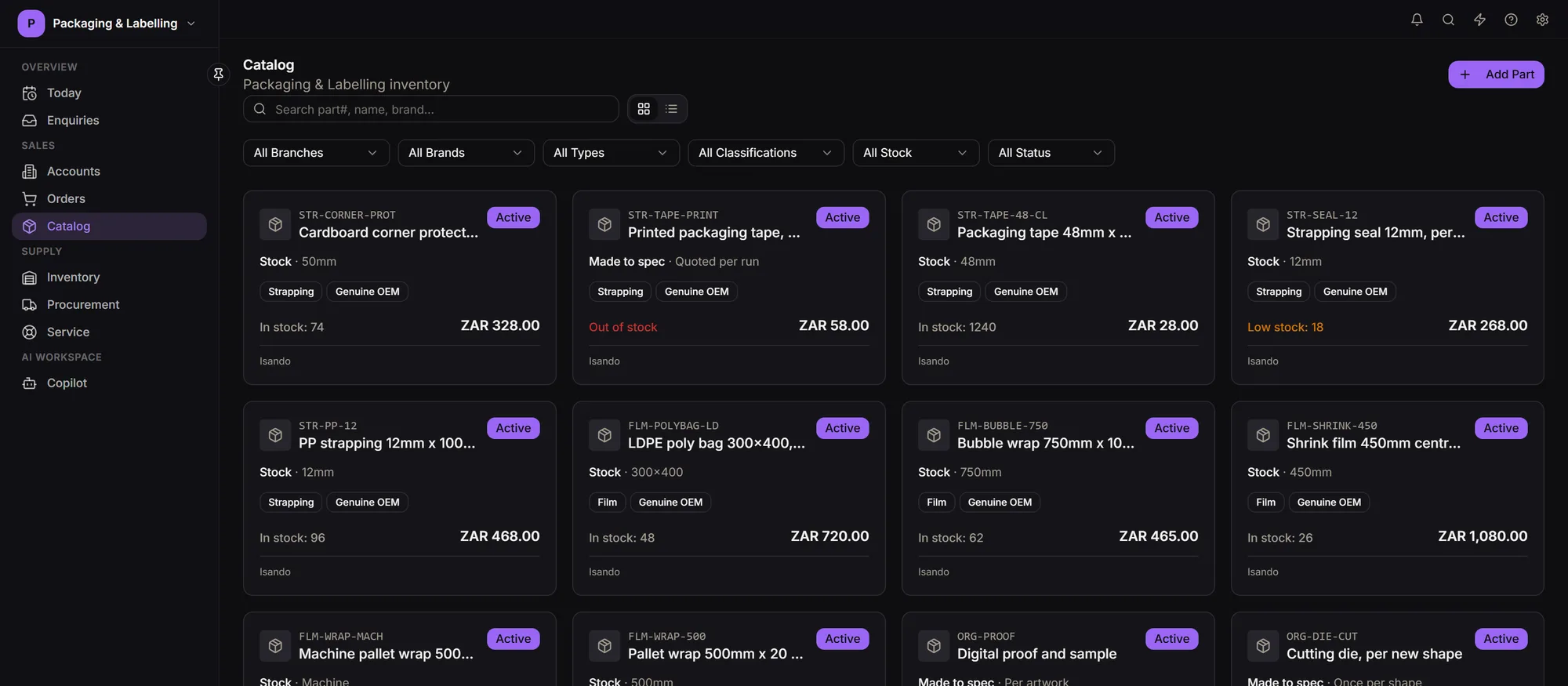
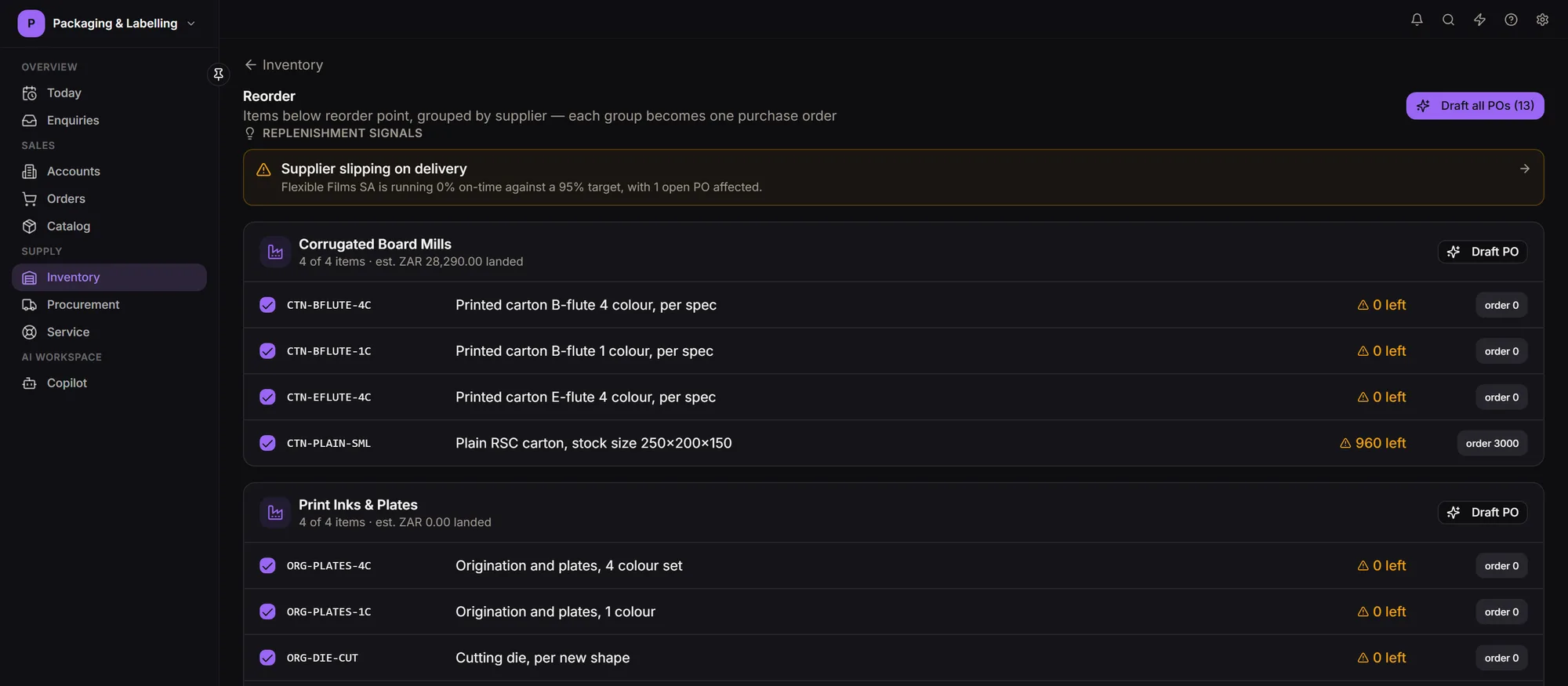
This trade does not lose money on one big thing. It loses it four small ways, every week, and none of them shows up until the year end.
The run quoted off last year’s board price
Corrugated moves. A specification repriced from the previous quote rather than from today’s cost is a job won at a margin that no longer exists.
Cost is read at the moment of quoting, so a repeat run is repriced against what the board costs now.
The origination absorbed to win the job
Plates and dies folded into the unit rate to make the number look better, then never recovered when the run is smaller than promised.
Setup is quoted as its own line, so what it cost and whether it was recovered are both visible.
The quote sitting on artwork sign-off
Specification work goes quiet for weeks while the customer approves a proof, and quotes die in that silence without anyone noticing.
Every quote out carries its value and its age, and the ones going cold surface while there is still something to save.
The consumables that ran out mid-job
Half this business is stock: tape, wrap, ribbon and thermal labels, and running out of them stops a despatch as surely as a missing carton.
Stock lines carry reorder points against real movement and raise the purchase order before the shelf is empty.
Nothing runs out quietly. Reorder points are held against real movement, so a shortfall is raised as a purchase order before it becomes a lost order.
Held against actual movement, rather than a number somebody set two years ago and never revisited.
The date the customer is given comes from the supplier who carries that part, not from optimism.
Stock booked in lands against the order that was waiting for it, and the short line on that job clears itself.
The screens on this page are the live platform, captured as it renders. The company, its customers, suppliers and every figure are generated for demonstration. No client of ours appears anywhere on this page.
Nothing that already works has to move. The finance team keeps their ledger, the branches keep their stock, and the counter keeps its speed. This sits over the top of all of it.
Your accounting package
Sage, Pastel, Xero or whatever the year end runs on stays where it is. Invoices raised here reach it, and the bookkeeper is not asked to learn a new ledger.
Your branches
Stock sits per branch and is quoted per branch, with what is available at the counter separated from what is sitting at another store or already in transit.
Your part numbers
Your own code, the supplier's and the OEM number all sit on the same line, so nobody has to translate between them mid-enquiry.
Your terms
Credit limits, payment terms and settlement discounts are held against the account and enforced when the order is taken, not discovered at month end.
Your counter
A walk-in is served at the same speed as before. The system is behind the counter rather than in front of it.
Your reps
What a rep quoted, what it was worth and whether it landed is on the account rather than in their own notebook.
Other distribution industries. Different stock and different customers, on the same run from enquiry to invoice.
Industrial & MRO
Industrial supplies, PPE and safety equipment, Chemicals and lubricants, and 1 more
Trade counter
Electrical and lighting wholesale, Plumbing and sanitaryware, Building materials and hardware, and 1 more
High-SKU parts
Auto parts and spares, IT hardware and print consumables, Electronics components
Contract & tender
Medical and dental consumables, Laboratory and scientific supply, Mining consumables and spares, and 3 more
Or see the distribution overview.
What made-to-spec suppliers ask.
See it on your business.
We build a version around what you sell and how you quote it, and show you it working. No paid audit, no obligation.